Saturday, January 17, 2015

Some sightings in early January from Stoung and Ang Trapeang Thmor

While working in Stoung from 10-12 January we flushed what must have been a Great Bittern in a small wetland. When it flew up I thought at first it was a female florican as it was large, had the same tawny colouring with black markings, but from the side profile it was clear it was an Ardeidae.

Also in Stoung we had a Black-necked Stork fly by and the ponds were still full of Painted Storks and pelicans.

At Ang Trapeang Thmor between 13-14 January we came across a group of 5 mostly sub-adult Greater Adjutants....


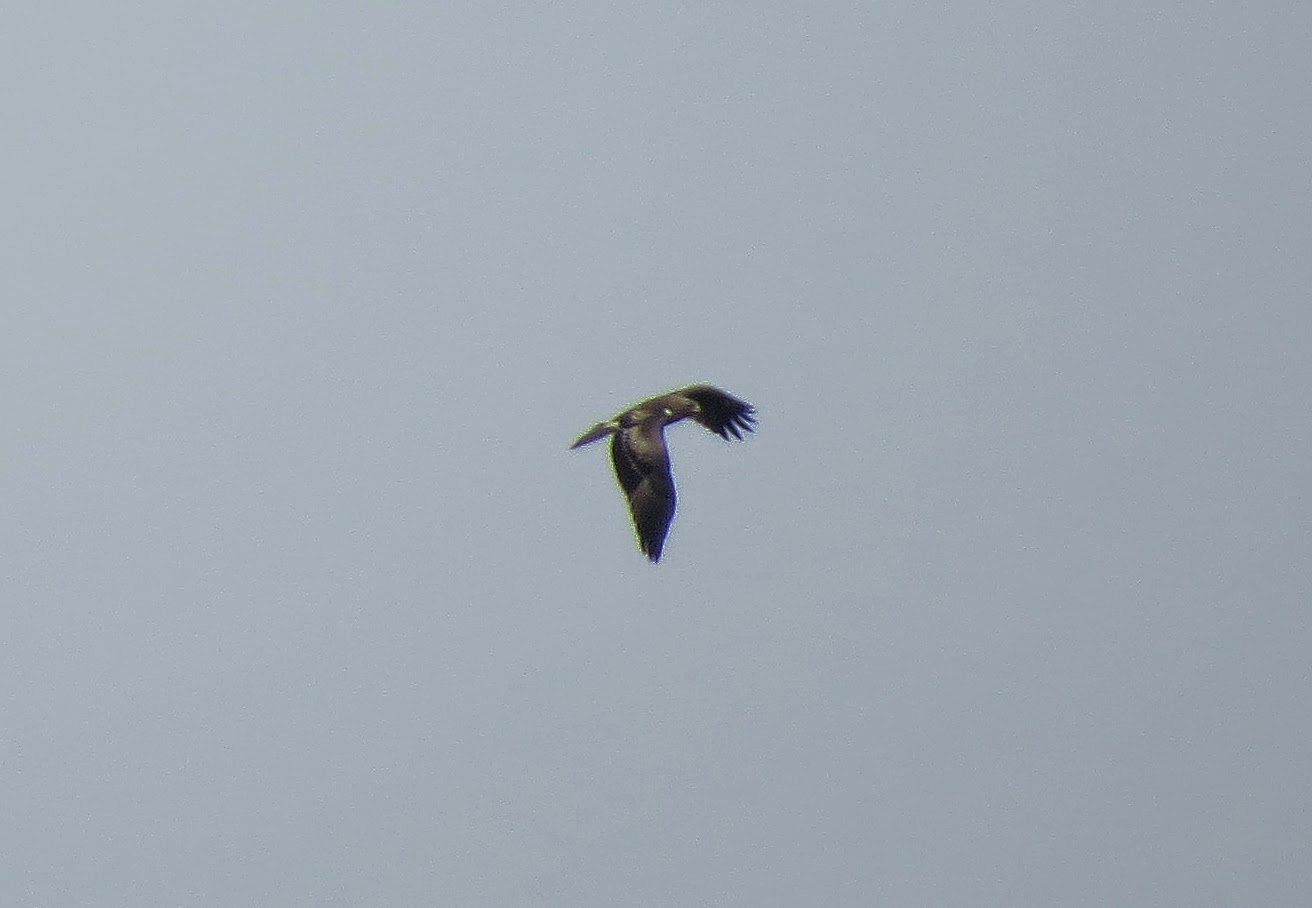
and a Booted Eagle circling nearby....


The bittern and eagle are first time sightings for me in Cambodia. The bittern has only been recorded a few times before in the country according to Frederic Goes's annotated checklist, while the eagle is also infrequently seen. January is a good time to visit Stoung and ATT  :-)  RvZ.

Saturday, December 27, 2014

Black-faced Spoonbill at BPL

On 23rd and 24th December a single Black-faced Spoonbill was seen at Boeung Prek Lapouv associating with a flock of Black-headed Ibis. First sighting was in a ploughed area near a village called Dei Leuk. The second sighting was in a natural inundated area not far from the village Banteay Sleuk.


Sightings of Black-faced Spoonbill at BPL have occurred before, in December 2010 and February 2012. Most sightings in and around BPL have been of birds within Black-headed Ibis flocks. The bird was spotted as it was the only one in the flock resting with it's bill tucked in under a wing. Just a few days before Simon Mahood had mentioned how lazy they seem to be in the daytime, more often than not seen catching a nap than actively foraging. With this in mind the Spoonbill stood out in the Ibis flock, of which all other birds were in full foraging mode.

Other sightings:
- 156 cranes counted at a single foraging site. There are more than that in BPL at the moment, as will become clear from the monthly site counts which took place this morning.
- Hundreds of Painted Storks and Asian Openbills and several large groups of Black-headed Ibis
- Perhaps as many as a thousand Garganeys
- A juvenile Peregrine Falcon, likely attracted by the presence of so many Garganeys


December is a good month to visit Boeung Prek Lapouv!

RvZ


Tuesday, October 7, 2014

Kampot over Pchum Ban


Hired a motorbike from Lucky Lucky Motorcycle shop on Monivong, Phnom Penh. Paid 13 USD per day, and the owners were very nice. They made sure I got a good motorbike that could go up the mountain. My plan was to try photograph the Chestnut - headed Partridge and then if possible, Mangrove Whistler and Ruddy Kingfisher.

Drove to Salt pans with Simon Mahood on 22nd evening and was able to photograph the Stints.

23rd disappointing drive up to Bokor; no Wreathed Hornbills, Great Hornbills or Chestnut - headed Partridge. No birds on the CHP trail. Went back to the salt pans alone and photographed the Marsh Sandpiper and possible Curlew Sandpiper.... if I am right!!

Lots of Common Sandpipers and Lesser Sand-plovers and Ringed Plovers also seen in the salt pans.

24th morning took a boat to  Trapeang Sangke CPA and found a Ruddy Kingfisher!!
Photos from the trip below:
                                          Blue - eared Barbet (Bokor)
                                         Thick-billed Green-pigeon (Bokor)
                                         Marsh Sandpiper (Kampot salt pans), with Simon
                                         Red-necked Stint (Kampot salt pans), with Simon
                                         Long-toed Stint (Kampot salt pans), with Simon
                                         Curlew Sandpiper (?) Kampot salt pans
                                         Ruddy Kingfisher (Trapeang Sangke CPA)
                                         Ruddy Kingfisher (Trapeang Sangke CPA)
Ashish J I John.

Tuesday, August 19, 2014

Kulen Promtep Wildlife Sanctuary in the wet season

I spent two weeks around various parts of Kulen Promtep. This was for my research, with very little opportunity for birding, but had some chances to observe birds in a type of habitat I rarely visit (deciduous forest). The forest is very wet and green at this time of year. All birds seen were resident species, with the possible exception of one (see below).

Best place to start is with the woodpeckers! Species seen included:
1) Grey-capped Pygmy
2) Rufous-bellied
3) Spot-breasted
4) Black-headed
5) Common Flameback
6) Greater Flameback
7) Rufous
8) Great Slaty

Other deciduous forest species:
- Giant Ibis (along trail to Veal Bromet)
- Indian Spotted Eagle (Veal Bromet)
- Rufous-winged Buzzard
- White-browed Fantail
- Brown Prinia

Other large waterbirds:
- Lesser Adjutant (seen almost daily, sometimes soaring in small groups)
- Sarus Crane


Other raptors:
- Oriental Honey Buzzard
- Crested Goshawk
- Chinese Goshawk (potentially: not minute, dark primary tips forming clear patches, flying due south)
- Crested Serpent Eaglesss

RvZ 

Wednesday, May 21, 2014

ATT and Stoung in May

Conditions at ATT were generally still nice and dry although there was a storm one of the afternoons we were there. Cranes (close to 200) were spending more time in the wetland than previous months and so did we. 4 Black-necked Storks were also present in the wetland and a Short-toed Snake Eagle flew over once. A male Bengal Florican was seen in the ricefield area just north of the wetland. These ricefields were actively being ploughed yet we came across an Oriental Pratincole "nest" with one egg.
Also in the ricefields we came across a victim of the heavy tractor traffic, a Copper-head Trinket Snake.
Many hundreds of Barn Swallows were still present in the wetland in front of the WCS office.

At Stoung it rained on the two consecutive evenings we were there. 50 or so Comb Ducks were seen feeding on rice spill in harvested dry season ricefield and 17 cranes were present as well. It was nice to see a female Greater Painted Snipe displaying, which consisted of raising wings for several seconds to flash bright white underwings while making the hooting sound described in Robson as blowing over an empty bottle.

Disclaimer: all nest photos I have put on the blog are not a result of active searches, but from coming across them by accident while doing fieldwork and making photos purely for the sake of documenting natural history. No harm was caused to the birds in any way and nests were left undisturbed as they were when found.

RvZ

Monday, May 12, 2014

Prek Ksach 10 April 2014

Sarah I spent an enjoyable couple of hours at Prek Ksach in the late PM.

The only notable birds were one Blue-eared Kingfisher and at least three calling Blue-winged Pittas, deep in the scrub. I assume they're staying to breed since they were around the previous week too. About 12 Alexandrine Parakeets were flying around, this is thought to be a feral population.

Simon Mahood

Thursday, May 8, 2014

A birding visit to Cambodia (Part II)


Kampot saltpans, 11 and 12 April PMs with Rob Overtoom, Nigel Eustace and Neil Furey

The habitat mosaic of the saltpans just east of Kampot town provided very pleasant birding grounds.

Best amongst the series of usual shorebirds was an Asian Dowitcher, although a glimpse just before dusk was a rather frustrating lifer. Nice were waders in near-breeding plumages such as Pacific Golden Plovers, Red-necked Stints and Curlew Sandpipers.

Bokor NP, 12 April AM with Rob Overtoom

A relatively productive birding visit for that time of the year, with 48 species harvested. The foothills were full of calling Blue-winged Pittas, a nice Blue-bearded Bee-eater a little further up, dipped on the Spot-bellied Eagle Owl (too late perhaps) and at mid-altitude, two wished species -- Large Scimitar Babbler and Banded Kingfisher -- were calling but could not be brought into views. On the plateau tea farm area, a Black Eagle granted us with repeated appearances (once really close) and a study of a white-eye concluded on the first record of Everett’s White-eye since the specimen collected in 1927 at the same site by Delacour and Jabouille. Lifer and bird of the day!

Prey Nup mangrove, 13 April with Rob Overtoom, Nigel Eustace and Neil Furey

Tuktuk and kayak birding, along the mangrove/cultivation edge and in the mangrove creeks respectively yielded 51 species. Crippling view of a Ruddy Kingfisher, two male Little Bronze Cuckoos ruffling over a mate, and a last-minute treat of wonderful views of a male Copper-throated Sunbird (lifer) were the highlights. The mangrove was really bird poor, and mostly enliven by an unmatched density of Pied Fantails.

Kampot river estuary, 13 April PM, with Rob Overtoom, Nigel Eustace and Neil Furey

High tide was just over, and starting to recede when we reached the estuarine mudflats at the day’s end. Small groups of a few regular species, although Cambodian firsts for me were 8-10 Common Terns (ssp longipennis) and a single Little Tern. Three Ruddy Turnstones were also hanging around.

Prek Ksach, 15 April, with Roland Seitre

Compared to my visit two weeks before, the big disappointment was that the Asian Golden Weaver colony had been overtaken by House Sparrows! Five Chestnut Munias were spotted though, so the site is probably the best bet to see that rare species in Cambodia. Of note was an active nest of Pied Bushchat: a straw-made cup nestled/lodged under a ploughed soil lump!

Sen Monorom plateau and Dak Dam, 16 to 20 April, with Roland Seitre and family, and Senglim

I spend the last week of my trip with wildlife photographer and major handbooks' contributor Roland Seitre, who I had met in Cambodia back in 1999. Birds everywhere were absurdly shy and nearly always 'unphotographiable', with the relative exception of our guest house compound, touristic parkings and Seima headquarters!!

Many species were busy breeding and I don’t list them here. Of distributional or status interest were a Bar-backed Partridge heard at the border post, Pale-capped Pigeon and Grey-headed Parakeet found fairly common around Sen Monorom, Speckled Piculet at O’Ramis and near Dak Dam, one Maroon Oriole near Dak Dam and calls matching those of Ratchet-tailed Treepie heard at two occasions but birds never showed for confirmation. A grey morph Black-headed Bulbul was also noteworthy. Unexpected was a Streaked Wren Babbler (ssp rufiventer) near Sen Monorom, the 2d record for the northeast. Local subspecies included klossi Blue-throated Flycatcher (widespread), germaini Black-throated Laughingthrush (O’Ramis), johnsi Black-throated Sunbird (O’Ramis) and possibly the first confirmation of nigricapillus Burmese Shrike, and supposed peracensis Lesser Racket-tailed Drongo (racket extending up to mid-shaft). The form of Ashy Bulbul looked more like the hildebrandi than the expected (based on distribution given in Robson’s guide) remotus subspecies.

Best lifer – and the bird of the trip – was a pair of gorgeous Silver-eared Mesias near Dak Dam on 16/4. The birds responded to playback on two subsequent visits, but did not want to show, to the great dismay of my companions.

Seima PF, 20 to 22 April, with Roland Seitre and family, Senglim and local guide Thoang

Time remaining was short to properly cover Seima PF, and unstable weather (rain or threatening sky in PM and even once in early AM) further shrunk our birding walks. The much sought-after and tricky Orange-necked Partridge gave me an UTV (untickable view) on the ONP trail after call playback on 21/4 PM. Nice consolation price was an at libitum and short-distance observation of a pair of Siamese Firebacks (they did not detect me!). The next morning on the O’Pam trail, several looks at Pale-headed Woodpeckers gave me trouble matching them with the Robson plates. Five other species of woodpeckers were around, including a family of Great Slaty Woodpeckers. ONPartridge was also heard calling.