Monday 14th January, the unmistakable call of a Savanna Nightjar started to resound from the roof of the University of Phnom Penh. It was dusk but I could see a male (white wing patch and tail corner) perched on a pole and uttering its call, sometimes answered by another bird in the backgarden trees.
There used to be a regular family roosting at the National Library, and hunting in central PP since the 1990's at least. So I wonder if this is another pair/group, ot if they have relocated to the outskirts...
Fredbaksey
Thursday, January 17, 2013

Monday, January 14, 2013
Confus(c)ion Spot-billed Ducks
Originally posted as "Chinese Spot-billed Ducks in Boeung Prek Lapouv"
Darn! These ducks can be difficult to determine!
Having gone to the Boeung Prek Lapouv wetland in Takeo province for a combined Black-faced Spoonbill and Asian Waterfowl Census, our group encountered several groups of Spot-billed Ducks. Close views, clear enough photographs (below) and dutiful consultation of the field guide led us to consider that these must be Chinese Spot-billed Ducks, as they lacked a red loral spot and had dark blue secondaries. However, it appears it is the moustachial stripe that distinguishes Chinese from Indian Spot-billed Ducks! Thanks James, for pointing this out. So, hopefully a lesson learnt for not only us, but others as well. The pictures below are Indian Spot-billed Ducks of the race haringtoni. See the closest match on Oriental Bird Images by using the following link http://orientalbirdimages.org/search.php?Bird_ID=183&Bird_Image_ID=5658&Bird_Family_ID=&p=65


Also a group of 12 Long-toed Stints were seen and photographed
 Participants: John Kennedy, Vanna, Sitha and Chea (BPL rangers), Robert van Zalinge
Darn! These ducks can be difficult to determine!
Having gone to the Boeung Prek Lapouv wetland in Takeo province for a combined Black-faced Spoonbill and Asian Waterfowl Census, our group encountered several groups of Spot-billed Ducks. Close views, clear enough photographs (below) and dutiful consultation of the field guide led us to consider that these must be Chinese Spot-billed Ducks, as they lacked a red loral spot and had dark blue secondaries. However, it appears it is the moustachial stripe that distinguishes Chinese from Indian Spot-billed Ducks! Thanks James, for pointing this out. So, hopefully a lesson learnt for not only us, but others as well. The pictures below are Indian Spot-billed Ducks of the race haringtoni. See the closest match on Oriental Bird Images by using the following link http://orientalbirdimages.org/search.php?Bird_ID=183&Bird_Image_ID=5658&Bird_Family_ID=&p=65


Also a group of 12 Long-toed Stints were seen and photographed

Sunday, December 23, 2012
More Small Pratincoles
This morning, 23 December, Howie Nielsen and I were at the ever changing Ly Yong Phat development over the Tonle Sap River north of Phnom Penh, aka Prek Ksach.
Most interesting to me were the numbers of Small Pratincoles. On September 2 Simon Mahood, Rob Martin and I saw a single Small Pratincole sat on a large deposit of sand recently dredged from the river, at the far east of the development, and I was interested as it was the first I'd ever seen away from the major rivers. Today there were 36 in exactly the same place. I'm guessing this might be the same place mentioned by Robert van Zalinge in his Nov 18 blog post "although the 50 or so Small Pratincoles were still around on 18 Nov." How many did you see and exactly where and when Robert? These are certainly the largest numbers ever seen away from the rivers. I'm assuming these birds will soon return to the Mekong as the river drops, but I wonder if they might stick around and try to breed? We also checked the old River Lapwing site in the west, but that has now grown over quite a bit and those birds appear to have definitely gone.
Here is a link to a google map, with what is now the "pratincole sand-hill" marked as #1 if anybody else wants to check it out. And below from my snappy camera is a competitor for the worst photo ever placed on the blog, which shows a portion of the flock:

We also found a newly dyked area in the north-western part beyond the golf course that was good for waders, with 4 Wood Sand, 1 Green Sand and 2 Greenshank along with the Little Ringed Plovers and Common Sands. Another area worth checking again and marked on the map as #2 in case anybody is going.
There were just 6 Oriental Darters and some Little Cormorants in the usual roosting area (marked #3 on the map). I assume most are in back in Prek Toal and other breeding areas around the Tonle Sap by now, but it also looks like the scrub in the area is dying back and may not be so suitable for these birds for much longer. Other than that there was the usual cast of waterbirds around the site, including good numbers of Pheasant-tailed and Bronze-winged Jacanas and an Osprey.
Colin Poole
Most interesting to me were the numbers of Small Pratincoles. On September 2 Simon Mahood, Rob Martin and I saw a single Small Pratincole sat on a large deposit of sand recently dredged from the river, at the far east of the development, and I was interested as it was the first I'd ever seen away from the major rivers. Today there were 36 in exactly the same place. I'm guessing this might be the same place mentioned by Robert van Zalinge in his Nov 18 blog post "although the 50 or so Small Pratincoles were still around on 18 Nov." How many did you see and exactly where and when Robert? These are certainly the largest numbers ever seen away from the rivers. I'm assuming these birds will soon return to the Mekong as the river drops, but I wonder if they might stick around and try to breed? We also checked the old River Lapwing site in the west, but that has now grown over quite a bit and those birds appear to have definitely gone.
Here is a link to a google map, with what is now the "pratincole sand-hill" marked as #1 if anybody else wants to check it out. And below from my snappy camera is a competitor for the worst photo ever placed on the blog, which shows a portion of the flock:

We also found a newly dyked area in the north-western part beyond the golf course that was good for waders, with 4 Wood Sand, 1 Green Sand and 2 Greenshank along with the Little Ringed Plovers and Common Sands. Another area worth checking again and marked on the map as #2 in case anybody is going.
There were just 6 Oriental Darters and some Little Cormorants in the usual roosting area (marked #3 on the map). I assume most are in back in Prek Toal and other breeding areas around the Tonle Sap by now, but it also looks like the scrub in the area is dying back and may not be so suitable for these birds for much longer. Other than that there was the usual cast of waterbirds around the site, including good numbers of Pheasant-tailed and Bronze-winged Jacanas and an Osprey.
Colin Poole
Tuesday, December 11, 2012
Bird Merit Release at Phnom Penh Riverside
Occassionally I go to check the cages where birds are held for merit release at a small temple along the river, opposite the Royal Palace. I did so today and although I did not find anything particular unusual I thought it would be good to post a blog about this practice. Tens if not hundreds of thousands of birds are sold every year (see article by N van Zalinge in Cambodia Bird News No.2). Lots of birds do not survive this ordeal, especially the insectivores like Barn Swallows, which starve to death in the period from capture to eventual release.
 Many are in such a weakened state that they are hardly capable of flight and catching food after their ordeal. In order to see it better I had this Sand Martin removed from a cramped cage full of hundreds of Barn Swallows and when released it was barely able to gain enough lift to fly up in to a tree.
 I saw hundreds of Scaly-breasted Munias being kept today (along with a few White-rumped), hundreds of Barn Swallows (and the single Sand Martin), plus a mix of a hundred or so Baya and Streaked Weavers. Among these birds were also 3 Blue-tailed Bee-eaters.


The main depot from which birds are transferred to smaller mobile cages to sell individual birds to temple visitors.
 Blue-tailed Bee-eaters with nothing to eat.
I hope that I am not the only one who sees this commercialisation of a religious ceremony with originally good intentions as twisted and cruel. What merit can be obtained through involvement in this business? Can a wish be granted through the purchase and release of a bird especially caught by traders for that purpose?
It is even possible for avian influenza to cross from bird to person by kissing the birds before release, as is the custom.
See http://www.univ-sante.edu.kh/mekong_sante_2011/download/journee_des_doctorantes/3-001.pdf and http://www.kfbg.org/content/99/16/1/misfortune_28_APR.pdf for more information
Robert


The main depot from which birds are transferred to smaller mobile cages to sell individual birds to temple visitors.

I hope that I am not the only one who sees this commercialisation of a religious ceremony with originally good intentions as twisted and cruel. What merit can be obtained through involvement in this business? Can a wish be granted through the purchase and release of a bird especially caught by traders for that purpose?
It is even possible for avian influenza to cross from bird to person by kissing the birds before release, as is the custom.
See http://www.univ-sante.edu.kh/mekong_sante_2011/download/journee_des_doctorantes/3-001.pdf and http://www.kfbg.org/content/99/16/1/misfortune_28_APR.pdf for more information
Robert
Saturday, December 1, 2012
Rous Van informed me that Finfoots were being seen in Steung Memai near Antil village. Richard Hillard, Van and I went on a trip to verify reliability of sightings. Waited for the bird 22nd for a whole day starting 6 am in the morning. Saw..

 Then at 5pm as I was about to call it a day, saw this object gliding on the water from the corner of my eye. Looked at it more carefully and there was the Masked Finfoot!! It was eating insects on the leaves hanging over the water. It slowly swam past me.

 Rous Vann saw another group with juveniles about 50 mts upstream, while Richard thought he saw another bird. The bird moved too quickly to be clearly identified and was very shy. Next day Richard and Van visited the only Greater Adjutant nest in KPWS, and I waited by a waterhole for the Coral-billed Ground-cuckoo. No luck but photographed
 a pair of Blue-bearded Bee-eaters (pair not shown in photo)
 One White-browed Scimitar-babbler

 Rours vann driving motorbike on the village road in Choamsrey.
Ashish John


One White-throated Rock-thrush. Then it started to rain! rained the whole evening, barely managed to reach the village. Next day everything was flooded!! Quaint village roads became rivers.. but reached Tbeng.

Ashish John
Thursday, November 22, 2012
Rufous-headed Robin in Phnom Penh
Two weeks ago I wrote an email to Andy Symes giving my opinion on the state of autumn birding in Phnom Penh:
"Autumn here has largely passed me by - Phnom Penh is literally rubbish for passerine migration, it's stuck in a little armpit of land, everything just cuts the corner and misses it out.".

On 15th November 2012 I stepped out of my house to go to work and saw a Luscinia hopping amongst the flower pots.
 Any Luscinia is a good bird, and any Luscinia is a very good garden bird, so I grabbed the DSLR and started blasting away.

To cut a long story short, the bird stubbornly refused to be shoe-horned into either Siberian Blue Robin or Rufous-tailed Robin. After extensive consultation with James Eaton and Paul Leader I was confident with the completely bonkers theory that there was a first winter female RUFOUS-HEADED ROBIN IN MY GARDEN!!!
The reality took more getting used to. I still haven't really fully processed it. This was like a dream come true, but it felt more like I was actually in a dream, dreaming about having a dream in which there was a first winter female RUFOUS-HEADED ROBIN IN MY GARDEN. I have checked passage and wintering Luscinias carefully since moving to Asia four years ago, hoping but never really expecting to find one of the rarer species. Now I had found one, in my own garden.

This bird is the:
First record of a first-year Rufous-headed Robin ever, anywhere in the world.
Second record of Rufous-headed Robin outside of the (tiny) breeding grounds in 49 years (the only other record is of a male mist-netted on Gunung Brinchang, Peninsular Malaysia in March 1963.
Best (closest, most prolonged, etc) views ever obtained of this elusive species, ever.
First time that a female has been photographed in the wild.
Best bird on my garden list.
To understand the context better take a look here

The Rufous-headed Robin was very tame and enjoyed its daily feed of mealworms. To say that it was confiding is an understatement. We spent many hours watching it feed, bathe, preen and roost. During all this time we were able to sit less than two meters away, often much closer, with the bird completely unperturbed. As well as being rare and beautiful, it was a delightful, charming bird and it was a pleasure to spend much time with it. It was last seen at midday on 20th November and Sarah and I already miss it very much.

I hope that these pictures convey some of the character of the bird, as well as the key identification features. Other people have got better photos and will no doubt post them online, but these are all my own. A paper is in preparation for Forktail.
Urban birding in Phnom Penh...does it get any better than this...?

Simon Mahood
"Autumn here has largely passed me by - Phnom Penh is literally rubbish for passerine migration, it's stuck in a little armpit of land, everything just cuts the corner and misses it out.".

On 15th November 2012 I stepped out of my house to go to work and saw a Luscinia hopping amongst the flower pots.
 Any Luscinia is a good bird, and any Luscinia is a very good garden bird, so I grabbed the DSLR and started blasting away.
To cut a long story short, the bird stubbornly refused to be shoe-horned into either Siberian Blue Robin or Rufous-tailed Robin. After extensive consultation with James Eaton and Paul Leader I was confident with the completely bonkers theory that there was a first winter female RUFOUS-HEADED ROBIN IN MY GARDEN!!!
The reality took more getting used to. I still haven't really fully processed it. This was like a dream come true, but it felt more like I was actually in a dream, dreaming about having a dream in which there was a first winter female RUFOUS-HEADED ROBIN IN MY GARDEN. I have checked passage and wintering Luscinias carefully since moving to Asia four years ago, hoping but never really expecting to find one of the rarer species. Now I had found one, in my own garden.

This bird is the:
First record of a first-year Rufous-headed Robin ever, anywhere in the world.
Second record of Rufous-headed Robin outside of the (tiny) breeding grounds in 49 years (the only other record is of a male mist-netted on Gunung Brinchang, Peninsular Malaysia in March 1963.
Best (closest, most prolonged, etc) views ever obtained of this elusive species, ever.
First time that a female has been photographed in the wild.
Best bird on my garden list.
To understand the context better take a look here

The Rufous-headed Robin was very tame and enjoyed its daily feed of mealworms. To say that it was confiding is an understatement. We spent many hours watching it feed, bathe, preen and roost. During all this time we were able to sit less than two meters away, often much closer, with the bird completely unperturbed. As well as being rare and beautiful, it was a delightful, charming bird and it was a pleasure to spend much time with it. It was last seen at midday on 20th November and Sarah and I already miss it very much.

I hope that these pictures convey some of the character of the bird, as well as the key identification features. Other people have got better photos and will no doubt post them online, but these are all my own. A paper is in preparation for Forktail.
Urban birding in Phnom Penh...does it get any better than this...?

Simon Mahood
Tuesday, November 20, 2012
Green-backed Flycatchers in Siem Reap Province
On 19th November Mardy Sean (SVC) found a male Green-backed Flycatcher at Beng Melea in Siem Reap province. This morning, whilst looking at the photographs on his camera I noticed a flycatcher in the SVC garden, Street 26, Wat Bo, Siem Reap. Which was also a male Green-backed Flycatcher Ficedula elisae. This was somewhat of a surprise. I obtained a few of photos, which are below.


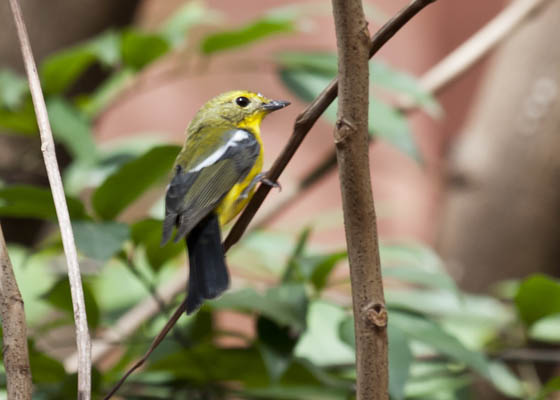
Also in the garden at the moment: one superb male Black-naped Monarch, at least 4 Taiga Flycatcher, Asian Brown Flycatcher, at least 3 Yellow-browed Warbler along with the resident Brown-throated and Olive-backed Sunbirds, Streak-eared and Yellow-vented Bulbuls and Zebra Doves.
Rob Martin
Subscribe to:
Posts (Atom)