Wednesday, February 6, 2013

Phnom Kraom January sightings

Having spent more time at the SVC office in Siem Reap since the New Year I've been heading out to the rice fields and lotus wetlands just north of Phnom Kraom more regularly. Best bird for me was undoubtably Chestnut-winged Cuckoo on two dates, 15th and 20th January. I suppose the Eurasian Coot seen with Simon Mahood on 25th may also be good! January species totalled 104, from 7 visits.

Coot. This is called 'putting the bird in a landscape context'.


Comb Ducks

Ducks have been sporadic, flocks of Comb Duck (13 on 15th and 15 on 25th Jan) and a maximum of 20 Garganey with the ever present Indian Spot-billed Ducks, Cotton Pygmy-Geese and Lesser Whistling Ducks, A Grey-headed Fish-eagle on 3rd January was perhaps expected given that the world's highest density breeds just over the Tonle Sap at Prek Toal but it's an impressive beast on the local patch. Other raptors included Osprey and Common Kestrel on 15th and Peregrine on 10th. Waders were a bit thin on the ground, Wood Sandpiper and Black-winged Stilt regularly noted but just one group of stints, 8 Long-toed Stint seen on 25th January, plus a couple of Greenshank. Numbers of Asian Openbill were increasing through the month, but only to 40 by 25th and there was only a single Painted Stork (15th).

Osprey, 15th January

White-shouldered Starlings
Regular stuff runs to Watercock and Greater Painted Snipe, over 100 Pheasant-tailed and a few Bronze-winged Jacanas, Black-backed Swamphens, Yellow and Cinnamon Bitterns. White-shouldered Starling are seen most days, with a maxima of 60 on 3rd January. One White Wagtail was present on 3rd January and a Red-throated Pipit passed over on 25th. A couple of Richard's Pipit were present at the start of January, but haven't been seen since the 6th.
In addition, Thick-billed Warbler, Siberian Rubythroat and Lanceolated Warbler are all birds guaranteed to quicken a British birders' pulse that I often bump into down t'marsh.
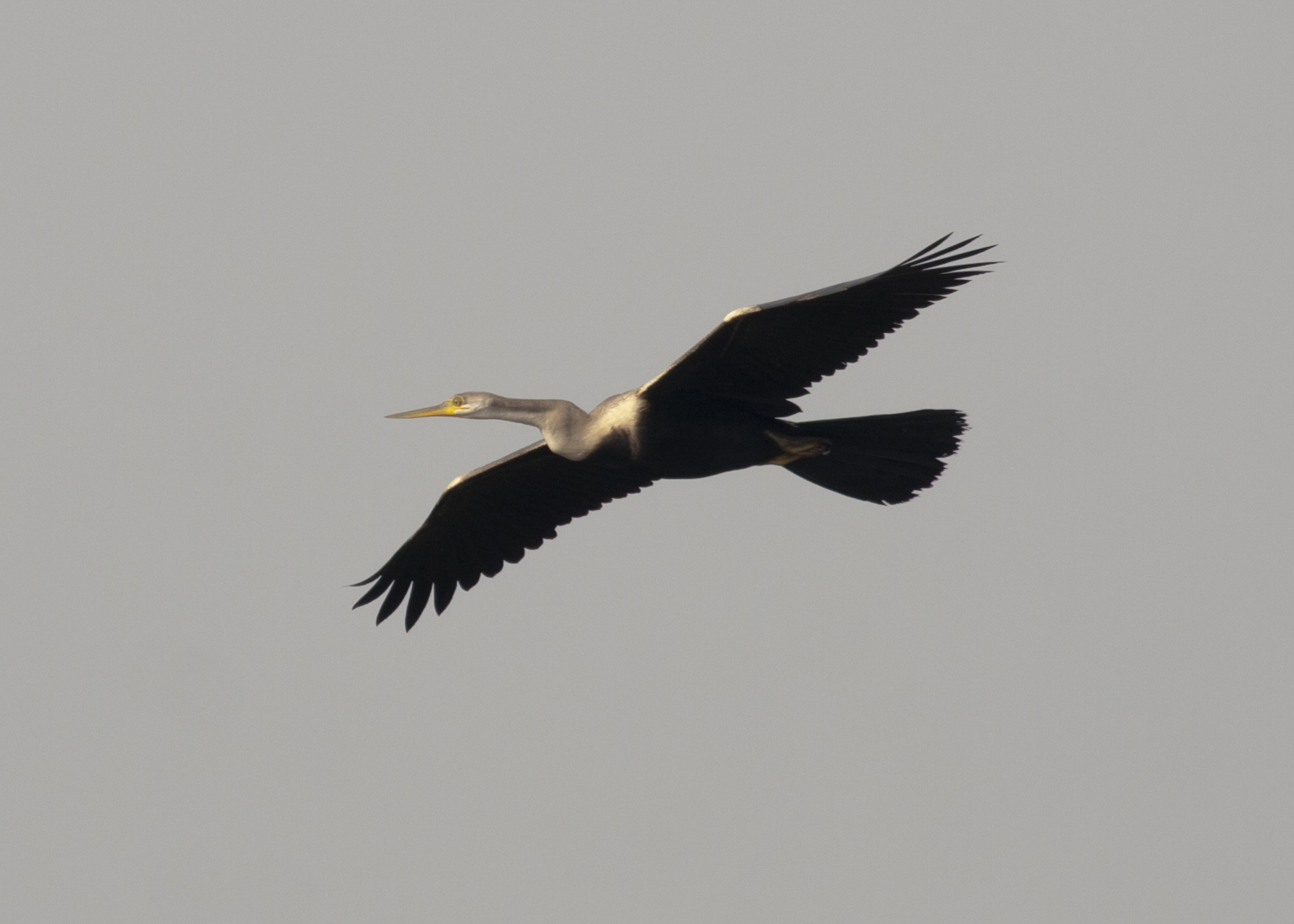
Oriental Darter
Rob Martin

Friday, February 1, 2013

Record count of Coots at ATT

During the AWC at ATT on 27-28 Jan, Rob Martin spotted very distant black floating ovoids he readily and confidently IDed as Common Coots. We took a boat to approach and soon we found ourselves in the middle of a flock of 72 coots! Adding the 4 birds seen elsewhere on the reservoir, 76 individuals is by far the largest number recorded in Indochina to the best of my knowledge.

This morning with Amaury and Michel, found a good spot near Phnom Kraom, with emergent aquatic grass (next time shall I khmer name!) hosting 5 duck species including 5 Comb Ducks.

Fredbaksey

Thursday, January 17, 2013

Savanna Nightjar student

Monday 14th January,  the unmistakable call of a Savanna Nightjar started to resound from the roof of the University of Phnom Penh. It was dusk but I could see a male (white wing patch and tail corner) perched on a pole and uttering its call, sometimes answered by another bird in the backgarden trees.

There used to be a regular family roosting at the National Library, and hunting in central PP since the 1990's at least. So I wonder if this is another pair/group, ot if they have relocated to the outskirts...

Fredbaksey

Monday, January 14, 2013

Confus(c)ion Spot-billed Ducks

Originally posted as "Chinese Spot-billed Ducks in Boeung Prek Lapouv"

Darn! These ducks can be difficult to determine!

Having gone to the Boeung Prek Lapouv wetland in Takeo province for a combined Black-faced Spoonbill and Asian Waterfowl Census, our group encountered several groups of Spot-billed Ducks. Close views, clear enough photographs (below) and dutiful consultation of the field guide led us to consider that these must be Chinese Spot-billed Ducks, as they lacked a red loral spot and had dark blue secondaries. However, it appears it is the moustachial stripe that distinguishes Chinese from Indian Spot-billed Ducks! Thanks James, for pointing this out. So, hopefully a lesson learnt for not only us, but others as well. The pictures below are Indian Spot-billed Ducks of the race haringtoni. See the closest match on Oriental Bird Images by using the following link http://orientalbirdimages.org/search.php?Bird_ID=183&Bird_Image_ID=5658&Bird_Family_ID=&p=65


Also a group of 12 Long-toed Stints were seen and photographed
Participants: John Kennedy, Vanna, Sitha and Chea (BPL rangers), Robert van Zalinge

Sunday, December 23, 2012

More Small Pratincoles

This morning, 23 December, Howie Nielsen and I were at the ever changing Ly Yong Phat development over the Tonle Sap River north of Phnom Penh, aka Prek Ksach. 

Most interesting to me were the numbers of Small Pratincoles. On September 2 Simon Mahood, Rob Martin and I saw a single Small Pratincole sat on a large deposit of sand recently dredged from the river, at the far east of the development, and I was interested as it was the first I'd ever seen away from the major rivers. Today there were 36 in exactly the same place. I'm guessing this might be the same place mentioned by Robert van Zalinge in his Nov 18 blog post "although the 50 or so Small Pratincoles were still around on 18 Nov." How many did you see and exactly where and when Robert? These are certainly the largest numbers ever seen away from the rivers. I'm assuming these birds will soon return to the Mekong as the river drops, but I wonder if they might stick around and try to breed? We also checked the old River Lapwing site in the west, but that has now grown over quite a bit and those birds appear to have definitely gone.

Here is a link to a google map, with what is now the "pratincole sand-hill" marked as #1 if anybody else wants to check it out. And below from my snappy camera is a competitor for the worst photo ever placed on the blog, which shows a portion of the flock:

We also found a newly dyked area in the north-western part beyond the golf course that was good for waders, with 4 Wood Sand, 1 Green Sand and 2 Greenshank along with the Little Ringed Plovers and Common Sands. Another area worth checking again and marked on the map as #2 in case anybody is going.

There were just 6 Oriental Darters and some Little Cormorants in the usual roosting area (marked #3 on the map). I assume most are in back in Prek Toal and other breeding areas around the Tonle Sap by now, but it also looks like the scrub in the area is dying back and may not be so suitable for these birds for much longer. Other than that there was the usual cast of waterbirds around the site, including good numbers of Pheasant-tailed and Bronze-winged Jacanas and an Osprey.
Colin Poole

Tuesday, December 11, 2012

Bird Merit Release at Phnom Penh Riverside

Occassionally I go to check the cages where birds are held for merit release at a small temple along the river, opposite the Royal Palace. I did so today and although I did not find anything particular unusual I thought it would be good to post a blog about this practice. Tens if not hundreds of thousands of birds are sold every year (see article by N van Zalinge in Cambodia Bird News No.2). Lots of birds do not survive this ordeal, especially the insectivores like Barn Swallows, which starve to death in the period from capture to eventual release.
 
Many are in such a weakened state that they are hardly capable of flight and catching food after their ordeal. In order to see it better I had this Sand Martin removed from a cramped cage full of hundreds of Barn Swallows and when released it was barely able to gain enough lift to fly up in to a tree.

I saw hundreds of Scaly-breasted Munias being kept today (along with a few White-rumped), hundreds of Barn Swallows (and the single Sand Martin), plus a mix of a hundred or so Baya and Streaked Weavers. Among these birds were also 3 Blue-tailed Bee-eaters.


The main depot from which birds are transferred to smaller mobile cages to sell individual birds to temple visitors.


Blue-tailed Bee-eaters with nothing to eat.

I hope that I am not the only one who sees this commercialisation of a religious ceremony with originally good intentions as twisted and cruel. What merit can be obtained through involvement in this business? Can a wish be granted through the purchase and release of a bird especially caught by traders for that purpose?

It is even possible for avian influenza to cross from bird to person by kissing the birds before release, as is the custom.

See http://www.univ-sante.edu.kh/mekong_sante_2011/download/journee_des_doctorantes/3-001.pdf and http://www.kfbg.org/content/99/16/1/misfortune_28_APR.pdf for more information


Robert


Saturday, December 1, 2012

Rous Van informed me that Finfoots were being seen in Steung Memai near Antil village. Richard Hillard, Van and I went on a trip to verify reliability of sightings. Waited for the bird 22nd for a whole day starting 6 am in the morning. Saw..

 Then at 5pm as I was about to call it a day, saw this object gliding on the water from the corner of my eye. Looked at it more carefully and there was the Masked Finfoot!! It was eating insects on the leaves  hanging over the water. It slowly swam past me.

Rous Vann saw another group with juveniles about 50 mts upstream, while Richard thought he saw another bird. The bird moved too quickly to be clearly identified and was very shy.  Next day Richard and Van visited the only Greater Adjutant nest in KPWS, and I waited by a waterhole for the Coral-billed Ground-cuckoo. No luck but photographed
a pair of  Blue-bearded Bee-eaters (pair not shown in photo)
 One White-browed Scimitar-babbler
 One White-throated Rock-thrush. Then it started to rain! rained the whole evening, barely managed to reach the village. Next day everything was flooded!! Quaint village roads became rivers.. but reached Tbeng.

Rours vann driving motorbike on the village road in Choamsrey.

Ashish John